US Launches Major Strikes on Iranian Targets Following Apache Helicopter Downing
US Launches Major Strikes on Iranian Targets Following Apache Helicopter Downing
US-Iran Tensions Escalate After Military Confrontation
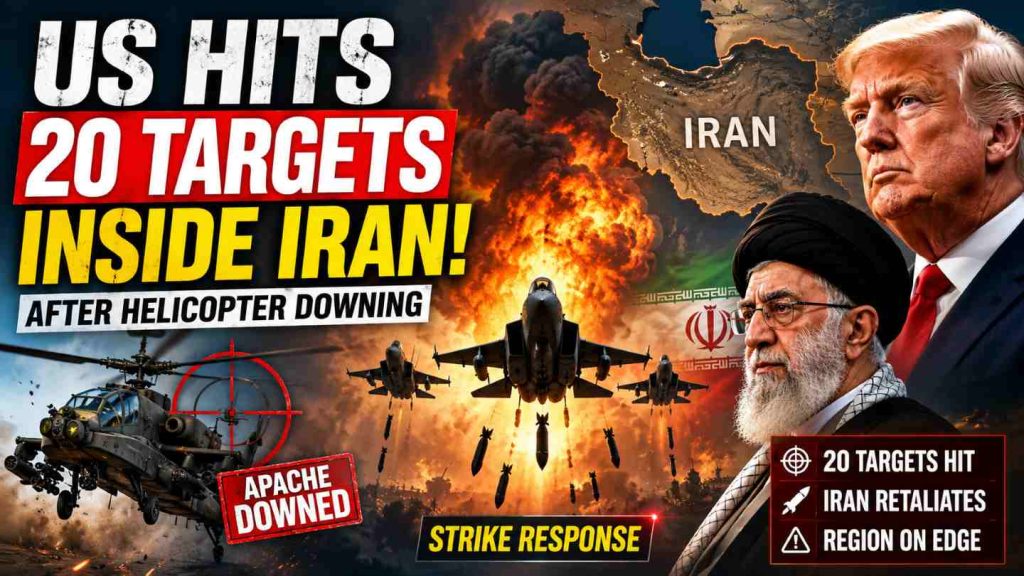
The United States launched a series of coordinated military strikes against nearly 20 Iranian targets following the reported downing of a U.S. Army Apache helicopter near the strategically important Strait of Hormuz. The operation marks one of the most significant escalations in tensions between Washington and Tehran in recent years and raises concerns about the possibility of a broader regional conflict in the Middle East.
According to U.S. officials, President Donald Trump authorized the strikes after Iranian forces allegedly shot down an Apache helicopter carrying two American crew members. Although both personnel were successfully rescued, the incident prompted an immediate military response aimed at degrading Iran’s defensive capabilities.
US Targets Iranian Air Defense and Radar Systems
A senior U.S. official confirmed that American fighter jets struck approximately 20 military sites across Iran. The targets reportedly included air defense systems, surveillance radar installations, and command-and-control facilities located near the Strait of Hormuz.
The U.S. Central Command (CENTCOM) stated that the strikes were intended to protect American forces and interests in the region while sending a clear message that attacks on U.S. military assets would not go unanswered.
Military analysts suggest that targeting radar and air defense infrastructure could pave the way for future operations if diplomatic efforts fail. By weakening Iran’s defensive network, the United States maintains strategic flexibility while increasing pressure on Tehran.
Iran Responds With Missile and Drone Attacks
Following the U.S. strikes, Iran issued a strong warning through its Foreign Ministry and military leadership. Iranian Foreign Minister officials declared that any attack on the country would be met with a firm response.
Shortly afterward, Iran reportedly launched missiles and drones targeting U.S. military installations in Bahrain, Kuwait, and Jordan. According to the Islamic Revolutionary Guard Corps (IRGC), the primary target was the U.S. Navy’s Fifth Fleet headquarters in Bahrain.
The retaliatory attacks highlight the fragile security situation across the Gulf region, where military forces remain on high alert amid fears of further escalation.
Diplomatic Efforts Continue Despite Rising Conflict
Despite the exchange of military strikes, President Trump continues to advocate for a diplomatic solution. The administration has been working to secure agreements that would ensure freedom of navigation through the Strait of Hormuz, limit Iran’s nuclear ambitions, and reduce instability across the region.
However, recent events have complicated those efforts. Analysts note that the helicopter incident and subsequent military exchanges demonstrate the deep mistrust between both nations.
While neither side appears eager to initiate a full-scale war, experts warn that continued military confrontations could quickly spiral into a larger conflict if diplomacy fails.
Regional Security Concerns Grow
The latest developments come amid ongoing instability throughout the Middle East. Iran-backed Hezbollah remains engaged in hostilities with Israel, and Israeli forces continue operations in southern Lebanon.
New evacuation orders have been issued to civilians in parts of Lebanon, suggesting additional military actions could occur in the coming days. Regional governments are also monitoring the situation closely, concerned that a widening conflict could threaten energy supplies and international shipping routes.
The Strait of Hormuz remains a critical global chokepoint through which a significant percentage of the world’s oil shipments pass. Any disruption in the area could have major consequences for global energy markets.
Innovative Rescue Mission Highlights Military Technology
One of the most remarkable aspects of the incident was the rescue of the two Apache helicopter crew members. Reports indicate that an unmanned surface vessel (USV) played a key role in extracting the pilots from danger and transporting them to safety.
Military experts describe the operation as a groundbreaking example of how emerging technologies are transforming modern warfare. The successful use of unmanned systems demonstrates the growing role of artificial intelligence, autonomous platforms, and advanced military innovation in combat operations.
Defense officials credit ongoing modernization efforts for enabling rapid deployment of these capabilities, which are increasingly becoming essential tools on today’s battlefield.
Uncertain Path Forward
As tensions between the United States and Iran continue to rise, the international community remains focused on whether diplomacy or further military action will shape the next chapter of the crisis.
While both nations appear to be carefully calibrating their responses, the situation remains highly volatile. With strategic interests, regional security, and global energy supplies at stake, the coming weeks could prove critical in determining whether the conflict escalates or moves toward a negotiated settlement.
For now, military forces across the Middle East remain on alert as the world watches one of the most consequential geopolitical confrontations unfold.
#USIranConflict #MiddleEastNews #IranStrikes #USMilitary #StraitOfHormuz #Geopolitics #BreakingNews #MilitaryOperations #GlobalSecurity #IranCrisis